

Emtional development during the early years lays the foundation for future resilience, confidence, and empathy. Here are five simple ways parents and caregivers can help nurture emotional well-being in young children.
1. Encourage Open Communication
It’s essential for children to feel safe expressing their emotions. Regularly talk to your child about how they’re feeling and offer reassurance that it’s okay to express emotions like happiness, sadness, or frustration. This helps them understand that all feelings are valid.
2. Model Healthy Emotional Responses
Children often mirror the emotional behaviors of adults around them. By showing patience, empathy, and calmness in challenging situations, you’re teaching your child how to manage their own emotions constructively.
3. Create a Routine
Children thrive on consistency and structure. Establishing a daily routine helps them feel secure and understand what to expect, reducing anxiety and fostering a sense of stability.

“The emotional well-being of children is just as important as their physical health, and nurturing it from a young age sets the foundation for a lifetime of resilience, empathy, and confidence.”
John Dery
4. Practice Positive Reinforcement
Acknowledging and celebrating small successes can boost a child’s self-esteem and encourage positive behavior. Whether it’s sharing toys or expressing their feelings in a healthy way, make sure to offer praise for their efforts.
5. Provide Opportunities for Play
Play is an essential part of emotional and social development. Through play, children learn to navigate social interactions, practice empathy, and develop problem-solving skills. Encourage imaginative play and interactive games that allow them to express their feelings and work through challenges.
Supporting Emotional Growth at Kiddie Daycare
At Kiddie Daycare, we integrate these principles into our daily routines, ensuring children are supported emotionally, socially, and intellectually. Through structured activities, free play, and consistent caregiving, we help children build the emotional tools they need to thrive in school and beyond.
Want your child to build strong social skills in daycare? See ACA Gainesville daycare programs or schedule a tour.
Research from the American Academy of Pediatrics confirms that high-quality childcare settings significantly support children’s social and emotional development.
The Group Setting Advantage
Single children raised at home with one or two adults have deep, rich relationships with those adults. But they do not have the peer social laboratory that group childcare provides. Every day in a quality childcare setting, children encounter situations they would rarely face in a one-on-one home environment: another child taking a toy they wanted, being excluded from a game, navigating friendship dynamics across a group, encountering unfamiliar social cues from peers with different personalities and communication styles.
These encounters are not just challenges to manage — they are the curriculum of social development. A child who has navigated five hundred peer conflicts by age 5 with coaching from skilled teachers has a social-emotional vocabulary and a conflict toolkit that a child without this experience simply does not have. This advantage is measurable in kindergarten social skills assessments and in teacher reports through the elementary years.
How Daycare Teachers Facilitate Social Learning
The difference between a daycare that produces social development and one that merely supervises children is the intentionality of the teaching. In quality programs, teachers are not just preventing and managing conflicts — they are teaching through them.
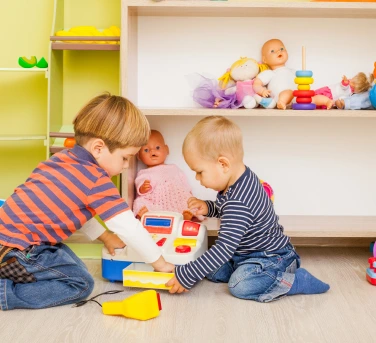
When two 3-year-olds want the same truck, a quality teacher does not simply resolve the dispute. They narrate what is happening (‘You both want the truck’), validate both perspectives (‘It is really hard to wait’), coach toward a solution (‘What could you do?’), and celebrate the resolution (‘You figured it out together’). This coaching, repeated across thousands of daily social interactions, is how children build a durable social-emotional toolkit.
Long-Term Social Outcomes of Quality Daycare
Studies tracking children who attended quality early childhood programs show higher social competence ratings from kindergarten through middle school, better peer relationships, lower rates of behavioral problems, and stronger emotional regulation across contexts. These effects persist even when controlling for family income, parent education, and other variables — the quality of early care has an independent effect on social development that is not explained away by selection bias.
When Daycare’s Social Benefits Show Up Most Clearly
The social development benefits of quality daycare tend to become most visible during the kindergarten transition. Kindergarten teachers consistently report that children who attended quality group care settings are better prepared for the social demands of school than those who did not — not necessarily because they know more academically, but because they already know how to navigate a group, take turns, resolve disagreements, follow group rules, and form relationships with adults outside their family.
This kindergarten advantage reflects years of daily social practice with teachers who coached every interaction. The child who has had five hundred turns in a quality daycare’s circle time already knows what circle time is, why it matters, and how to participate. The child for whom kindergarten circle time is a new experience is learning the rules of participation at the same time as the content — a divided attention that makes everything harder.
Making the Most of Daycare’s Social Opportunities
Families can amplify the social development benefits of quality daycare by reinforcing social-emotional learning at home. Use the same feeling vocabulary your child’s teachers use. Ask about peer situations at the end of the day and coach from a problem-solving frame rather than a judge-and-punish frame. Model conflict resolution when disagreements arise at home. And take seriously any concerns about a child’s social development that teachers raise — early intervention for social-emotional delays produces dramatically better outcomes than watchful waiting.
See Social Development Happen at A Child’s Academy
The social development benefits of quality daycare are most visible in the day-to-day interactions of children who have been in our program for months or years. The 3-year-old who comforts a crying friend, the toddler who offers their toy to a child who is upset, the preschooler who negotiates rather than escalates — these are the outcomes of intentional, consistent, relationship-based early childhood care.
We invite you to spend time in our classrooms during your tour. Watch the children interact with each other and with our teachers. The social-emotional environment you observe will tell you more about what we offer than any description we could provide.
Choose a Program That Takes Social Development Seriously
Not all daycare programs place equal emphasis on social-emotional development. Some manage behavior reactively — responding to conflicts after they happen with consequences. Others teach social skills proactively — coaching interactions, building emotional vocabulary, and developing children’s capacity for self-regulation before it is tested.
The difference between these approaches is visible in classrooms. Proactive programs have less conflict, faster resolution when conflict does occur, and children who demonstrate genuine social competence rather than just compliance. A Child’s Academy is a proactive program. We invite you to observe the difference in our classrooms.
Building the Social Foundation: What Happens in Quality Daycare
The social dynamics of a daycare classroom are fundamentally different from home — and that difference is precisely what makes them so developmentally valuable. In a quality daycare setting, children must navigate relationships with peers they didn’t choose, manage shared resources, wait for adult attention, and recover from inevitable conflicts. These daily challenges, guided by skilled and responsive caregivers, become the training ground for lifelong social competence.
The Social Skills That Develop in Daycare
- Turn-taking and sharing — Among the earliest social skills to emerge, typically developing between ages 2 and 3 with consistent, supportive practice
- Reading social cues — Learning to recognize when a peer is upset, excited, or disinterested based on facial expression, tone, and body language
- Verbal conflict resolution — Moving from crying or physical behavior toward using words: a developmental shift that happens between ages 2 and 5
- Group entry skills — Learning how to join a group already at play without disrupting the dynamic
- Empathy and perspective-taking — Beginning to understand that other children have different feelings, needs, and viewpoints
- Following group norms — Participating in circle time, transitions, and shared routines that require collective cooperation
The Caregiver’s Role in Social Development
These skills don’t develop automatically — they require responsive, skilled caregiving. Quality daycare teachers don’t just manage behavior; they coach social skills in real time. When two toddlers reach for the same toy, a skilled caregiver narrates the conflict (“You both want the truck”), validates both children (“It’s hard to wait”), and guides them toward a solution (“Who had it first? Let’s find another one for you”). This interaction, repeated dozens of times each day, builds the social reasoning capacity children carry with them for life.
A Child’s Academy teaching staff are trained in social-emotional learning facilitation. Schedule a tour to observe our classrooms firsthand and see how our teachers build social skills into every part of the day.
Invest in Social Development From the Start
The social skills that children build in high-quality daycare settings don’t just help them make friends — they form the foundation for academic engagement, teacher relationships, teamwork, and emotional regulation throughout their entire educational journey. Research consistently shows that children who receive responsive, high-quality early care develop stronger social competence that persists into adolescence.
At A Child’s Academy, social-emotional development is a central pillar of our curriculum, not an afterthought. Our teachers are trained to coach social skills in the moments that matter — during conflict, during collaboration, during the ordinary peer interactions that become extraordinary developmental opportunities. Schedule a visit to see our approach in action.