

ootional development during the early years lays the foundation for future resilience, confidence, and empathy. Here are five simple ways parents and caregivers can help nurture emotional well-being in young children.
1. Encourage Open Communication
It’s essential for children to feel safe expressing their emotions. Regularly talk to your child about how they’re feeling and offer reassurance that it’s okay to express emotions like happiness, sadness, or frustration. This helps them understand that all feelings are valid.
2. Model Healthy Emotional Responses
Children often mirror the emotional behaviors of adults around them. By showing patience, empathy, and calmness in challenging situations, you’re teaching your child how to manage their own emotions constructively.
3. Create a Routine
Children thrive on consistency and structure. Establishing a daily routine helps them feel secure and understand what to expect, reducing anxiety and fostering a sense of stability.

“The emotional well-being of children is just as important as their physical health, and nurturing it from a young age sets the foundation for a lifetime of resilience, empathy, and confidence.”
John Dery
4. Practice Positive Reinforcement
Acknowledging and celebrating small successes can boost a child’s self-esteem and encourage positive behavior. Whether it’s sharing toys or expressing their feelings in a healthy way, make sure to offer praise for their efforts.
5. Provide Opportunities for Play
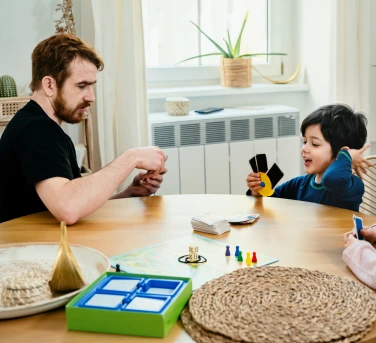
Play is an essential part of emotional and social development. Through play, children learn to navigate social interactions, practice empathy, and develop problem-solving skills. Encourage imaginative play and interactive games that allow them to express their feelings and work through challenges.
Supporting Emotional Growth at Kiddie Daycare
At Kiddie Daycare, we integrate these principles into our daily routines, ensuring children are supported emotionally, socially, and intellectually. Through structured activities, free play, and consistent caregiving, we help children build the emotional tools they need to thrive in school and beyond.
Experience play-based learning at A Child’s Academy in Gainesville. See our preschool programs.
According to NAEYC’s research on the importance of play, play-based learning builds the foundation for literacy, numeracy, and social-emotional development.
The Neuroscience of Play and Learning
Play activates more areas of the developing brain simultaneously than any other activity available to young children. When a child builds a block tower, they are using spatial reasoning, fine motor coordination, causal logic, and perseverance. When they engage in dramatic play, they are using language, narrative thinking, emotional perspective-taking, and creative problem-solving. These multi-domain activations create the richly connected neural networks that underlie complex thinking in later years.
Direct instruction — sitting at a table and learning from a teacher — activates different neural circuits and is less effective for children under age 7 for most learning goals. This is not an opinion; it is one of the most robustly supported findings in developmental neuroscience. Young children learn through play not because we want learning to be fun, but because that is how their brains are built to learn.
The Play-Based vs. Academic Debate: What the Research Says
Multiple longitudinal studies have compared play-based preschool programs with more academic, direct-instruction approaches. The findings are strikingly consistent: by third grade, any short-term academic advantages of early formal instruction have faded. By middle school, children from play-based programs show stronger creativity, problem-solving, and social-emotional skills — and equal or better academic performance.
The most widely cited study, following German preschool children through their school years, found that children from play-based programs consistently outperformed those from academic programs on multiple outcomes measured through fourth grade. Similar findings have been replicated in U.S., UK, and Nordic research contexts.
What Play-Based Learning Looks Like in Our Classrooms
Play-based learning does not mean unstructured time. In quality play-based programs, teachers design environments, ask questions, introduce materials, and scaffold interactions in ways that have clear developmental intentions. The difference from traditional instruction is that children are active agents in their learning rather than passive recipients.
Our teachers observe children at play to understand what each child is ready to learn next, then create opportunities — through the environment, through provocations, through materials and questions — for that learning to happen naturally. This responsive, child-led approach requires more professional skill than traditional instruction, which is why it is found more often in higher-quality programs.
Defending Play in an Achievement-Pressured Culture
The cultural pressure to accelerate children’s academic development has intensified over the past two decades, driven by parental anxiety about college admissions, economic competition, and the misguided belief that earlier is always better when it comes to academic skill development. This pressure has filtered into early childhood programs in the form of worksheet-heavy curricula, academic drills for toddlers, and the elimination of recess in some kindergartens.
The research does not support this trend. The same studies that show advantages for play-based preschool graduates over direct-instruction graduates also show higher rates of creativity, intrinsic motivation, and academic self-efficacy in the long run. Children who learn to love learning through play build the internal drive to pursue learning for its own sake — the quality that sustains academic engagement through high school and beyond, long after any early academic head start has faded.
How to Identify a Genuine Play-Based Program
Many programs claim to be play-based without delivering on the promise. A genuine play-based program will be able to explain specifically how play serves as a vehicle for developmental goals in each age group. Teachers can articulate what a child is learning from a specific play scenario. The environment is designed with developmental intention, not just stocked with toys. And assessment practices capture learning that happens through play, not just performance on structured tasks.
Choosing a Program That Gets Play Right
Not every program that claims to be play-based actually is. In your search for a Gainesville early childhood program, ask specifically: how does play serve as a vehicle for learning in your program? What does a lead teacher do to extend children’s thinking during play? How do you document what children are learning through play?
Programs that have genuinely built their curriculum around play-based learning will answer these questions specifically and enthusiastically. Programs that use ‘play-based’ as a marketing label will give you vague answers. At A Child’s Academy, we are always happy to walk families through the specific ways play drives learning in each of our classrooms.
Play-Based Learning in Practice
The best way to understand what quality play-based learning looks like is to observe it. In a well-designed play-based classroom, you will see children deeply engaged in self-chosen activities, teachers asking open-ended questions and extending children’s thinking, and learning happening in every corner of the room simultaneously.
A Child’s Academy welcomes families who want to observe our classrooms and see play-based learning in action. Schedule a tour during an active part of the morning and spend time watching what the children and teachers are actually doing. The quality of that experience will tell you everything you need to know about our program.
Play-Based Learning at Home: Activities for Every Age
The play-based philosophy that guides quality preschools extends naturally into home life. You don’t need elaborate toys or structured lesson plans — everyday play is rich with learning when approached with some intention.
Ages 0–2: Sensory and Exploratory Play
- Fill a bin with dry rice or oatmeal and let your baby explore with hands and cups — builds sensory processing and early fine motor skills
- Stack and knock down cups or soft blocks repeatedly — teaches cause and effect, a foundational concept in scientific thinking
- Read the same simple board books over and over — repetition builds vocabulary and language comprehension more effectively than novelty at this age
Ages 2–4: Pretend and Constructive Play
- Set up a dramatic play area (kitchen, doctor’s office, grocery store) and let your toddler lead — develops language, social understanding, and narrative thinking simultaneously
- Build with blocks and ask your child to describe what they’re building — connects spatial reasoning and geometry concepts with language development
- Open-ended art without a “right answer” — scribbling, painting, and clay build creativity and fine motor strength without the pressure of producing a correct product
Ages 4–6: Problem-Solving and Collaborative Play
- Simple board games teach turn-taking, counting, and handling disappointment gracefully — all critical kindergarten skills
- Building projects with cardboard boxes and tape encourage engineering thinking and spatial problem-solving
- Collaborative storytelling — you start a story and your child adds the next part — builds narrative comprehension and creative thinking together
The activities children explore at home reinforce the skills they’re building in their early childhood program. A Child’s Academy teachers are always happy to suggest home activities that connect to current classroom themes — reach out to start the conversation.
Choose a Program That Takes Play Seriously
In an era when many preschools are being pushed toward earlier academic instruction, programs that maintain a rigorous commitment to play-based learning are doing something genuinely difficult — and something the research strongly supports. Finding a preschool where play is understood as the vehicle for learning, not the reward at the end of a worksheet, is one of the most important choices a parent can make for their young child.
A Child’s Academy in Gainesville has been committed to play-based education since our founding. Our teachers understand developmental science, implement it daily, and can explain to any curious parent exactly why a child stacking blocks is doing mathematics. Schedule a tour and let us show you what intentional play-based learning looks like in a real Gainesville classroom.